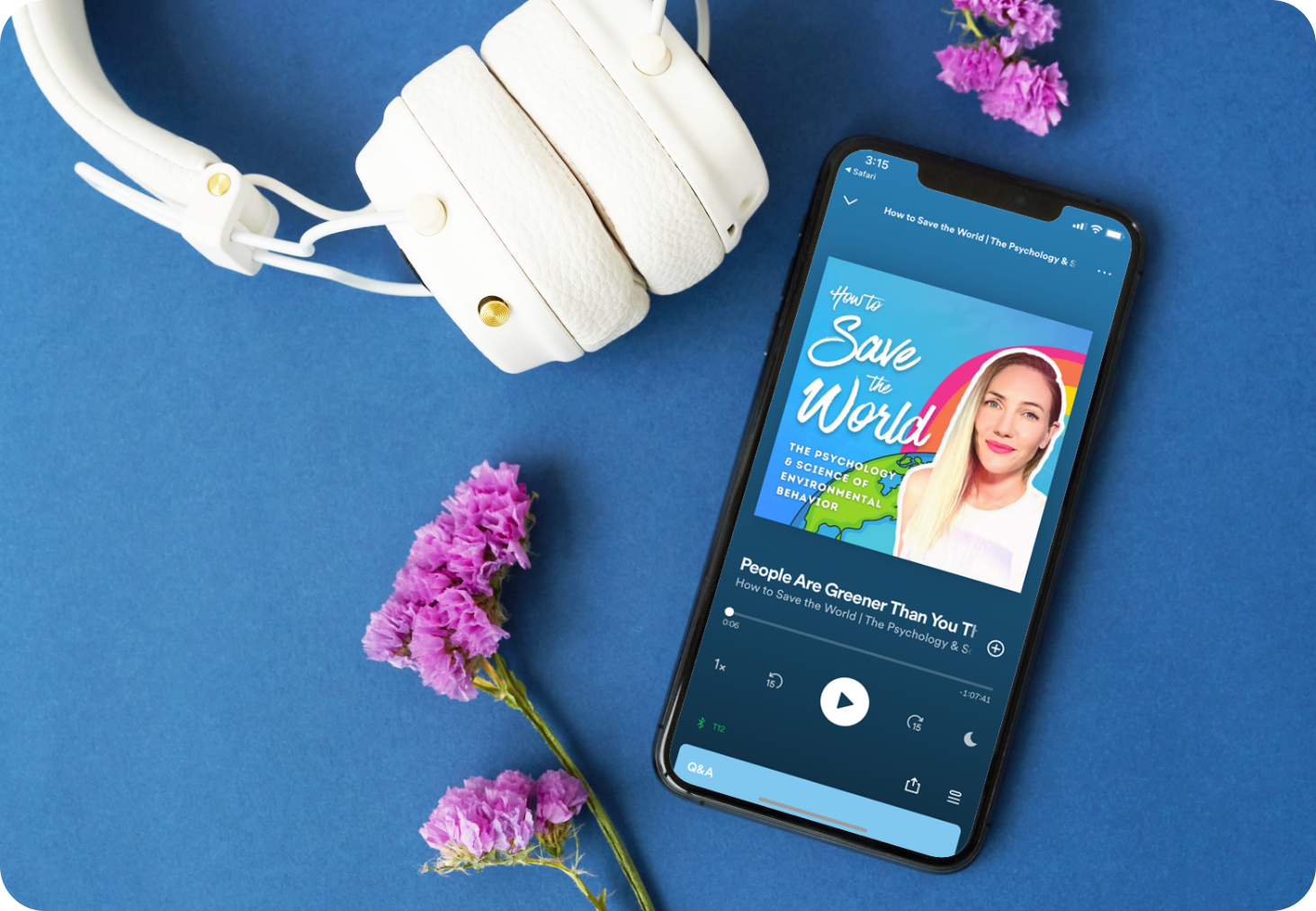
How to Save the World Podcast

Environmental Engineer and Hello World Labs Founder, Katie Patrick, explores peer-reviewed research with leading environmental psychologists and behavioral scientists on what drives pro-environmental behavior.
Design Tools
Learning
Free Access

The How to Save the World Podcast, hosted by environmental engineer and action designer Katie Patrick, explores the field of environmental psychology by interviewing the world’s leading environmental psychologists and behavioral scientists.

Each episode delves into peer-reviewed academic research to uncover the true mechanisms and causality behind what drives pro-environmental behavior.

These insightful conversations form the foundation for the design techniques used at Hello World Labs, supporting custom design work and group training programs.

Listeners can also experience Katie’s Environmental Psychology Masterclass series, featuring 30 of the world’s top behavioral scientists in environmental change, making the podcast a critical resource for anyone looking to understand and inspire real-world environmental action.

Subscribe to the Podcast.

Free Access

Psychology Techniques

Ambient Messaging

A signal or message displayed in the ambient environment such as on a wall or street where all passers-by can see it.

Block Leader

A self-appointed community leader who talks to neighbors on nearby streets and brings them together to support residential environmental goals.

Character Expressions

The facial expression of a character animal or emoji is used to communicate data as "happy" or "sad" in lieu of using a number or color.

Color Signal

Color systems that signal good or bad performance instantly.

Commitment Device

A mechanism that causes someone to make a verbal or written promise to another person to complete an action.

Community Scale Feedback

Publicly displayed data showing a community's collective environmental impact as a group.

Constructive Imagination

Active creative exercises involving writing, drawing, or building models of eco solutions.

Design Tools

Tools and systems to design better behavior-informed products of change.

Disclosure

When the government enforces mandatory disclosure of environmental impact in the form of a label or sticker that must be displayed at the point of sale.

Feedback Loop

A system that measures the environmental impact of an action and displays it with continuous feedback to the actor.

Group Goal

When a group collectively works together towards a shared goal to help maintain persistent motivation.

Groups

Putting people into groups as a way to create accountability, social cohesion, and social diffusion that leads to persistent behavior change.

Identity

Ways to enhance people's environmentally conscientious identity is a foundation to persistent intrinsic motivation.

Interactivity

An interactive experience designed to increase people's emotional attachment to the issue.

Marketing Funnel

A system for attracting the attention of new people and converting them into customers.

Novelty

An exciting and unusual experience helps to attract attention, build emotional resonance, and make information stick.

Rewards

A digital, physical, or emotional reward given to the participant after they complete a task or improve their performance.

Social Diffusion

The mechanism of how behaviors, values, and preferences spread from one person to another via social contact.

Social Signaling

A tool for people to publicly display their green performance that stimulates others to imitate the behavior.

Time & Place

A prompt or alteration to the way the person interacts with their immediate physical environment.

Time-Based Challenge

Applying a specific start and end date for a behavior increases people's propensity to commit to the action.

Tracking Progress

A mechanism for tracking progress towards a goal that brings attention to, and rewards progress.

Social Comparison

Comparing an objective measure of one person or entity's environmental score against others or against the group average.